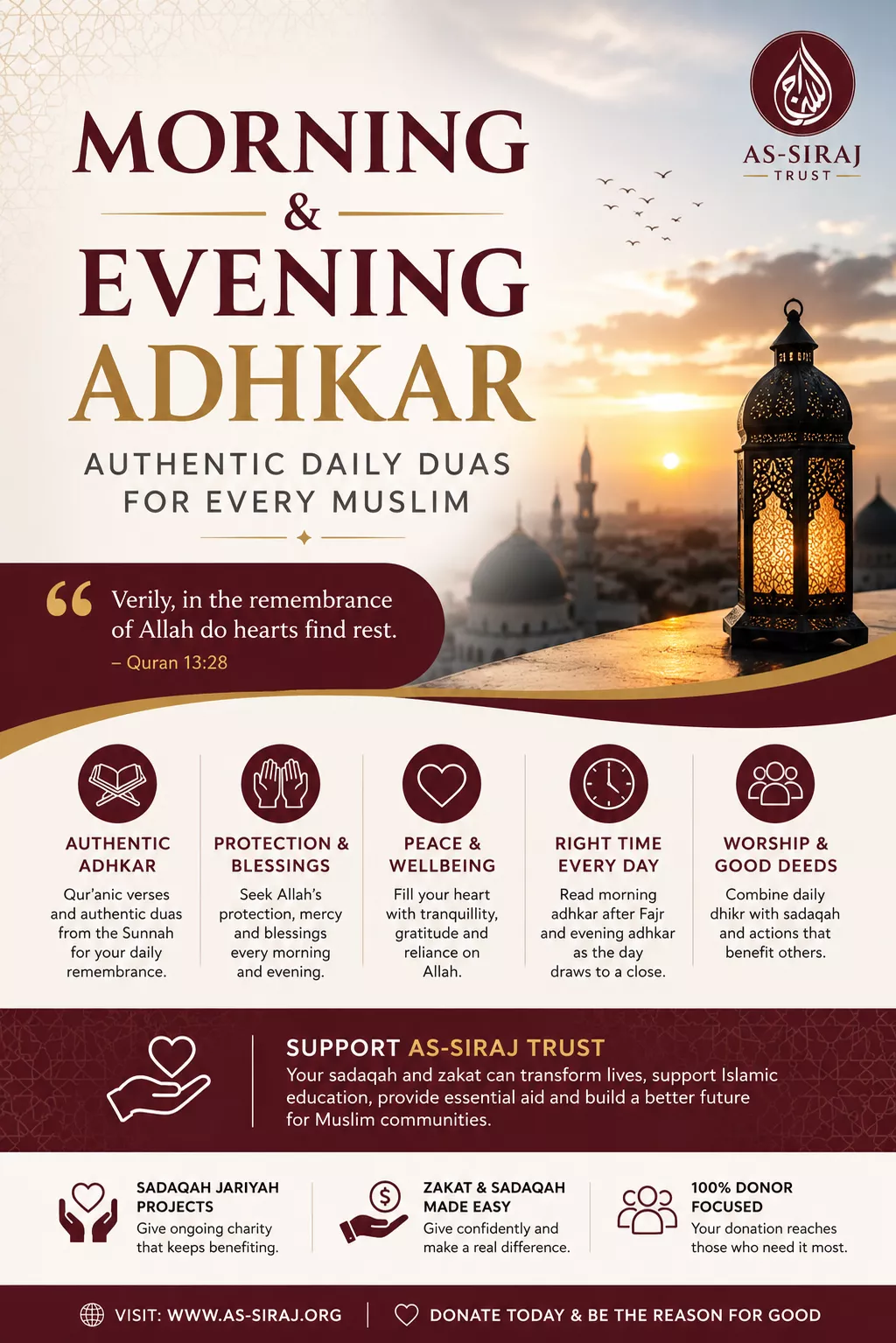
Morning and Evening Adhkar are forms of daily remembrance of Allah that help Muslims begin and end the day with worship, protection and gratitude. As-Siraj Trust encourages believers to learn daily Islamic duas, practise daily dhikr and use authentic Islamic supplications alongside sincere action and charitable giving.
What Are Morning and Evening Adhkar and Why Are They Important?
Morning and Evening Adhkar are prescribed remembrances drawn from the Qur’an and authentic Sunnah, including praise, protection, repentance and supplication. They matter because regular daily adhkar keeps remembrance of Allah present through ordinary daily life and supports a disciplined relationship with worship.
Adhkar means remembered words and phrases through which you praise Allah, seek forgiveness, ask for protection and renew your dependence on Him. Authentic practice draws from the Qur’an and reliable Prophetic reports, helping you build a disciplined rhythm of morning and evening duas without turning worship into an empty routine.
For a UK Muslim balancing work, school, commuting and family life, daily remembrance of Allah creates a simple spiritual anchor around ordinary routines. The Qur’an links remembrance of Allah with reassurance of the heart. Daily Islamic supplications from authentic Sunnah sources preserve specific morning and evening formulas, repetitions and meanings for believers to follow.
Authentic Morning Adhkar for Protection, Blessings and Remembrance of Allah
Authentic morning adhkar include Qur’anic recitations and Prophetic supplications reported for the start of the day, often with specified repetitions. These morning duas focus on protection, gratitude, repentance, wellbeing and reliance upon Allah rather than superstition or unsupported guarantees.
A practical morning dhikr routine can begin with Qur’anic protection, praise, repentance and supplication. Reported morning remembrances include reciting Al-Ikhlas, Al-Falaq and An-Nas three times, alongside the established morning dua for protection “Bismillahil-lazee la ya-dur-ru ma’as-mihi shai’un fil-ardi wa la fis-sama’i, wa Hu-was-Sami’ul-‘Alim” three times and Sayyid al-Istighfar with sincere conviction.
Keep the routine realistic enough to repeat every day. Read the Arabic carefully, learn the translation and check each formula against a dependable hadith source before adding it. Morning and Evening Adhkar work best as conscious worship, not rushed phrases squeezed between notifications, breakfast and the morning commute.
Authentic Evening Adhkar and Daily Duas Before Night
Authentic evening adhkar include recognised supplications and remembrances recited as the day moves into evening, with several formulas shared with the morning routine. Evening duas should remain distinct from separate bedtime supplications when the source gives them different contexts.
A steady evening dhikr routine mirrors much of the morning practice, with several narrations explicitly prescribing the same supplications in both periods. You can include recognised protection duas, words of contentment with Allah as Lord and repeated remembrance that keeps gratitude and reliance active as daylight fades and responsibilities slow down.
Do not automatically merge evening adhkar with bedtime duas because the two categories can carry different timings and texts. Treat evening remembrance of Allah as its own worship period, then use separately established sleep supplications when going to bed. This distinction keeps your practice clearer and closer to the wording preserved in hadith collections.
Best Morning and Evening Duas for Protection and Peace
The strongest adhkar for protection are supported by reliable Islamic texts, including daily Islamic supplications seeking refuge, wellbeing and forgiveness. Their purpose is worship and reliance upon Allah, not a promise that every worldly difficulty will immediately disappear.
For protection-focused practice, prioritise duas with clear textual evidence rather than viral graphics or unsourced social posts. One reported morning dua for protection is also transmitted as an evening dua for protection: “Bismillahil-ladhi la yadurru…” three times. Other authentic remembrances seek forgiveness, wellbeing, refuge from evil and steadfast faith in Allah.
Peace in Islamic remembrance is not a promise that every difficulty disappears immediately. Instead, dhikr directs the heart back to Allah through trust, gratitude and supplication. The Qur’an specifically associates remembrance of Allah with hearts finding comfort, giving daily Islamic supplications a deeper purpose than simply repeating protective phrases.
When Should You Read Morning and Evening Adhkar?
Morning and Evening Adhkar are tied to the morning and evening periods rather than one universal civil-clock time. UK Muslims can organise morning adhkar and evening adhkar around reliable local prayer timetables while seeking scholarly guidance for detailed timing questions.
Build your routine around the recognised morning and evening periods rather than a rigid clock time copied from another country. The narrations themselves commonly describe recitation in the morning and evening, not one universal civil-clock hour. In Britain, seasonal daylight changes make local prayer timetables a practical reference for planning a consistent routine.
Consistency matters more than making the routine complicated. If your schedule changes through winter and summer, attach morning remembrance of Allah to Fajr or your early-day routine. Link evening remembrance of Allah to the later part of the day. For precise timing questions, follow a trusted local scholar or mosque whose methodology you understand.
Benefits of Daily Adhkar and Dhikr in Islam
Daily dhikr strengthens consistent remembrance of Allah and authentic texts connect specific adhkar with reward, forgiveness and protection. The Qur’an also links daily remembrance of Allah with comfort of the heart, giving Islamic supplications and daily duas a clear spiritual purpose.
Daily dhikr strengthens a believer’s habit of remembering Allah through ordinary moments instead of limiting worship to occasional emotional peaks. Authentic texts connect particular Islamic supplications with rewards, forgiveness and protection, while the Qur’an describes remembrance as a source of reassurance for believing hearts. That makes consistency spiritually meaningful, even when the routine feels simple.
The strongest benefit comes from combining daily duas with attention, understanding and obedience. Learn what each dua means, pronounce it carefully and let its message shape your choices after recitation. Morning and Evening Adhkar should support prayer, repentance, gratitude and good character rather than becoming a substitute for obligatory worship or responsible action.
Combine Daily Adhkar With Sadaqah and Good Deeds
Pairing Morning and Evening Adhkar with sadaqah can make charitable giving in Islam part of a wider routine of worship. As-Siraj Trust gives UK donors a practical route to support Islamic charity work across education, healthcare, basic needs and emergency relief.
Remembrance and charity can reinforce the same daily intention: turning faith into conscious action. After completing your morning or evening dhikr, you might set aside a modest sadaqah, help someone directly or support a verified charitable project. This creates a practical bridge between personal worship and charitable giving in Islam that benefits other people.
As-Siraj Trust is registered with the Charity Commission for England and Wales under charity number 1194011, and its listed activities include general charitable purposes and religious activities. Its website highlights education, healthcare, basic-needs provision and emergency relief, giving UK donors practical ways to explore Islamic charitable giving and donate to Islamic causes.
Give Sadaqah Jariyah and Support Those in Need With As-Siraj
To donate sadaqah jariyah is to support charitable benefit intended to continue beyond the original gift. As-Siraj Trust presents sadaqah jariyah projects involving water, education, shelter, community support and mosque development for donors seeking longer-lasting impact.
Sadaqah Jariyah focuses on continuing benefit, so choose projects whose usefulness can genuinely endure rather than relying on a label alone. When you make a sadaqah donation or give sadaqah online, review the project carefully. As-Siraj Trust presents water, education, shelter, community support and mosque development as longer-term charitable options.
Support As-Siraj Charity – Donate Online and Make a Lasting Difference
You can donate to Islamic charity through As-Siraj Trust, a registered charity in England and Wales under number 1194011. Its Gift Aid recognition can strengthen a qualifying Islamic charity donation, while eligible UK donors may increase its value without paying extra themselves.
You can donate to charity online through As-Siraj Trust after reviewing the chosen appeal and any restrictions on your online Islamic donation. The Charity Commission lists the trust as recognised by HMRC for Gift Aid. Eligible charities can reclaim 25p per £1 on qualifying donations, while the Fundraising Regulator’s current Code sets UK fundraising standards.
1. What are Morning and Evening Adhkar?
Morning and Evening Adhkar are authentic Islamic remembrances, Qur’anic verses and supplications recited at the beginning and end of the day. They help you remember Allah, seek protection, express gratitude and strengthen faith through a consistent daily routine rooted in the Qur’an and authentic Sunnah.
2. When is the best time to read morning and evening adhkar?
Morning adhkar are generally read during the early part of the day while evening adhkar are recited as the day moves towards evening. UK Muslims can follow reliable local prayer times because sunrise and sunset vary significantly throughout the year, especially between winter and summer.
3. Which duas should I include in my daily adhkar?
Your daily adhkar can include authentic supplications for protection, forgiveness, wellbeing and gratitude alongside recognised Qur’anic recitations. Common examples include Al-Ikhlas, Al-Falaq, An-Nas and established Prophetic duas. Always verify the wording and repetition from dependable Islamic sources before adding any supplication to your routine.
4. Can I combine daily adhkar with sadaqah and other good deeds?
Yes. Daily dhikr and sadaqah can complement each other by connecting personal worship with practical generosity. After completing your adhkar, you may choose to support someone in need or contribute through As-Siraj Trust, helping turn remembrance of Allah into meaningful charitable action that benefits wider communities.
5. How can I support As-Siraj Trust after reading my daily adhkar?
You can support As-Siraj Trust through suitable charitable projects, sadaqah or other eligible donations according to your intention. As-Siraj Charity is registered in England and Wales under charity number 1194011, giving UK donors a recognised route to support humanitarian, educational and community-focused charitable work.